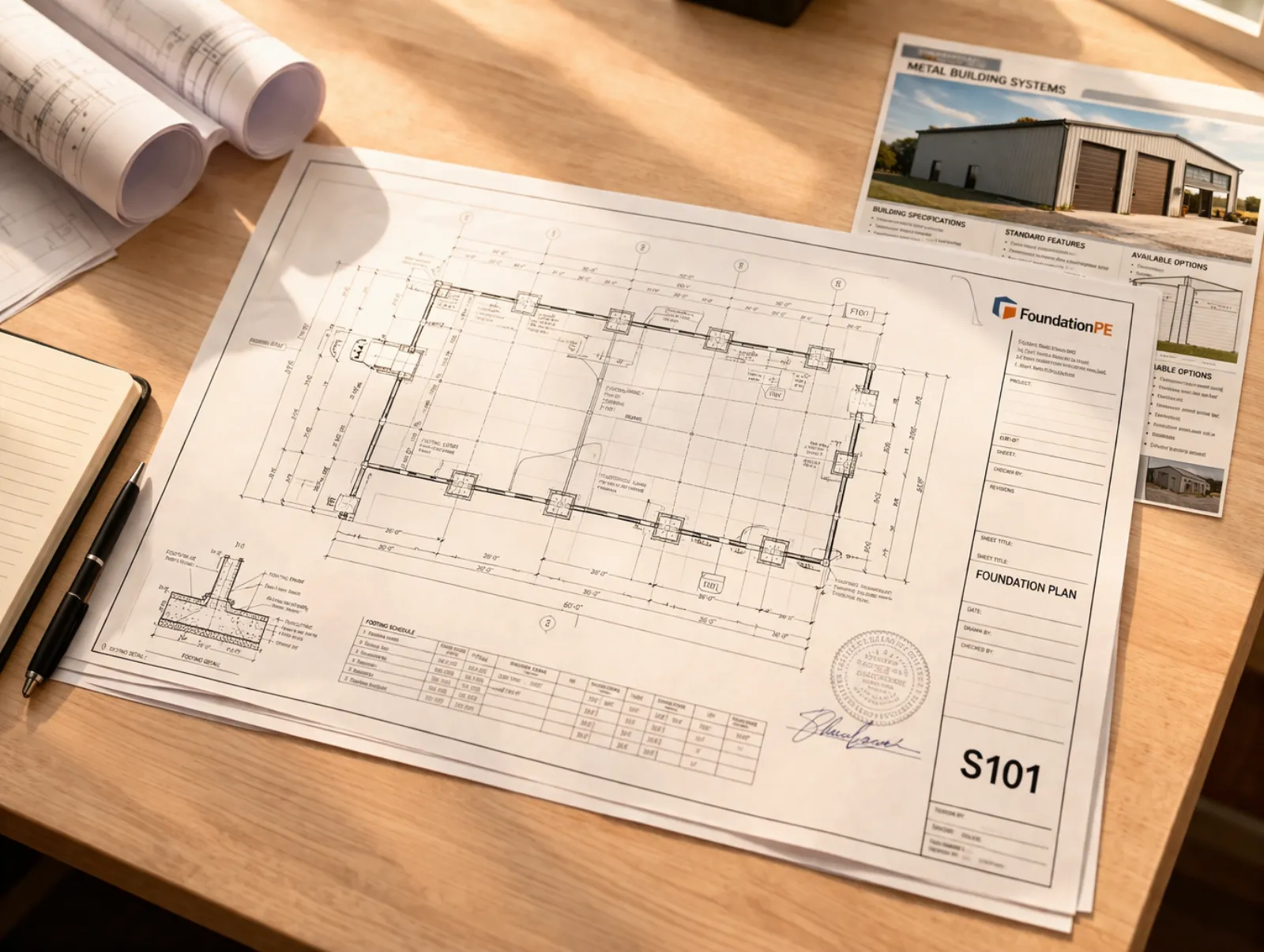
When a contractor orders a foundation engineering package, they expect to receive something they can hand directly to the building department and break ground with. But not every engineering firm delivers the same thing. Some send partial drawings. Others skip the calculations. A few stamp plans they clearly didn't review themselves.
At FoundationPE, every package — at every pricing tier — includes five core deliverables. Here is what each one is, what it contains, and why it matters for your permit.
1. The Foundation Plan (S101)
The foundation plan is the primary drawing in every package. It is a scaled, dimensioned plan view of the entire foundation system. It shows footing locations and sizes, slab dimensions and thicknesses, pier spacing and depths, anchor bolt patterns and edge distances, and overall building dimensions tied to the manufacturer's reaction data.
This is the drawing the contractor builds from and the building official reviews first. If the foundation plan is incomplete or unclear, the permit gets rejected before anyone even looks at the calculations.
2. Structural Details
Structural details are the cross-section and connection drawings that show how the foundation is actually built. These include typical footing cross-sections with rebar size, spacing, and cover dimensions. They also include pier details showing reinforcement and dowel patterns, slab-on-grade sections with wire mesh or rebar callouts, anchor bolt embedment and projection details, and any special connection details required by the manufacturer's reaction loads.
Details are where the building department confirms that the design is constructable and code-compliant. Missing or vague details are one of the most common reasons for permit review comments.
3. General Notes
The general notes page contains the code references, material specifications, and design assumptions that govern the entire package. This includes the applicable building codes: IBC 2024, ACI 318-19, ASCE 7-22. It also includes concrete compressive strength, typically 3,000 or 4,000 PSI. Reinforcing steel grade, typically Grade 60. Soil bearing capacity assumptions, either from a geotechnical report or code-prescribed presumptive values of 1,500 to 2,000 PSF. Special inspection requirements if applicable. And any jurisdiction-specific notes required by the local building department.
General notes are not filler. They are part of the engineering record and reviewers check them against local amendments and site conditions.
4. Calculation Package
The calculation package is the engineering math that proves the design works. It documents load paths from the building superstructure through the foundation to the soil. It includes footing sizing calculations based on gravity, wind, and seismic loads. Overturning and sliding checks for each load combination. Bearing capacity verification against the assumed or reported soil values. And anchor bolt design including tension and shear capacity.
Some jurisdictions require the full calculation package with the permit submission. Others only require it to be available on request. Either way, a complete calculation package means the engineer actually designed the foundation rather than just drawing one.
5. PE Stamp and Signature
The PE stamp certifies that a licensed Professional Engineer reviewed the design, verified the calculations, and takes legal responsibility for the work. It includes the engineer's name, license number, state of licensure, signature, and date.
Without a valid PE stamp for the state where the project is located, the building department will not accept the plans. Period.
Why This Matters
A complete foundation engineering package — plan, details, notes, calculations, and stamp — is what separates a first-submission permit approval from weeks of back-and-forth with the building department. When any piece is missing, the review stalls. The permit gets delayed. The project sits.
At FoundationPE, every package at every tier includes all five deliverables. There is no stripped-down version. There is no "calculations available upon request" asterisk. Every package is complete, permit-ready, and stamped by a licensed PE in the project's state.